en
 fr
 es

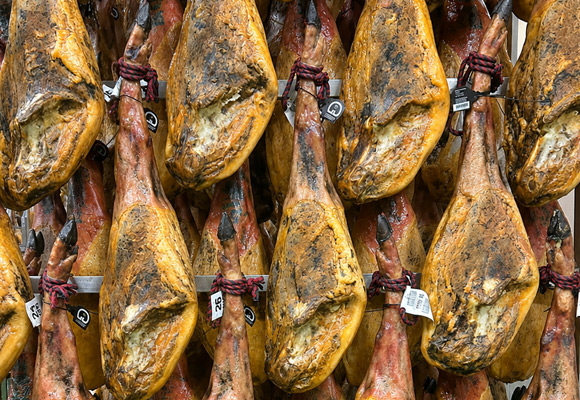
At an altitude of 1,000 metres, south of Salamanca, a small Castilian town has been making ham for centuries. In 1986, Guijuelo gave its name to the first designation of origin for Iberian ham, today the largest by volume. Dry winters, drying rooms open to the sierra, at least a thousand days of curing for an acorn-fed ham: here is everything you need to know to choose a Guijuelo ham.
The town has around 5,400 inhabitants, but it is the heart of a production area of 78 municipalities, nestled between the Sierra de Béjar and the Sierra de Francia. In this article, we explain what gives this ham its character, how it is checked from the dehesa to the cellar, and how to recognise it. For an overview of the Spanish designations, see also our page on the designations of Iberian ham and Serrano ham.
Guijuelo, where hams are cured slowly
1. Guijuelo, five centuries of know-how
1.1. From muleteers to the railway
The specifications of the designation trace the trade in matanza products (the traditional pig slaughter) back to the 16th century. At the time, it was the arrieros, the muleteers, who carried and sold hams and cured sausages.
As early as the Middle Ages, the Duke of Béjar called for Guijuelo's products, which also featured in the offerings made to the Virgen de Yedra in the neighbouring village of Ledrada. In 1892, the journalist Wanderer devoted an article to Candelario, "el país de los jamones y chorizos", the land of hams and chorizos.
The turning point came in 1880: pig slaughtering in Guijuelo took on an industrial scale, driven by the main road and the railway. The matanza, until then a family affair, became a daily activity from October to May. To discover this tradition, read our article on the matanza festival in Linares de la Sierra.
1.2. 1986: the first designation for Iberian ham
The rules of the Guijuelo designation were approved by the Spanish Ministry of Agriculture in June 1986. According to its Regulatory Council, it is the first designation of origin for Iberian ham recognised in Spain and in the world. The European Union registered it as a Protected Designation of Origin in 1996. The designation therefore celebrates its 40th anniversary in 2026.
The specifications were revised in 2025. This new version, published in Spain's Official Gazette on 1 September 2025, opens the designation to 50% Iberian pigs and lengthens curing times "to ensure slow, natural drying", according to the Regulatory Council. The other Iberian designations have challenged this opening to 50%.
1.3. The designation today
Key figures for 2026
| Indicator | Value |
|---|---|
| Acorn-fed pigs slaughtered for the PDO, 2025-2026 montanera | around 45,000 (over 40% more than the previous season) |
| Acorn-fed pigs certified by the four Iberian PDOs, 2025-2026 | 100,845, i.e. 16.86% of Spain's acorn-fed pigs |
| Guijuelo's share of PDO acorn-fed pigs | nearly 45% |
| Member companies | 40 |
| Drying rooms and cellars / slaughterhouses / cutting rooms (2022) | 47 / 9 / 30 |
| Farmers and farms (2022) | around 400 farmers, 1,000 farms |
| Protection of the name | European Union and 16 non-EU countries |
The Regulatory Council, based in Guijuelo, has 24 members, half of them farmers and half producers. It is accredited by ENAC, Spain's national accreditation body, and carries out official controls on behalf of the Ministry.
The name itself is protected: only certified products may be called "Guijuelo". The designation sums it up in one phrase: "si no es DOP, no es Guijuelo", if it isn't PDO, it isn't Guijuelo.
2. The Guijuelo pig, from birth to the dehesa
The specifications follow the pig step by step. To find out more about this animal and its environment, see our page on raising Iberian pigs in the dehesa.
2.1. One breed, three levels of purity
The designation accepts the pure Iberian pig and its crosses with the Duroc breed, provided it is at least 50% Iberian. The parents are registered in their breed's herd book. The Duroc brings early maturity and a better carcass yield.
- 100% Iberian: pure Iberian father and mother;
- 75% Iberian: Iberian mother and a father who is himself born of an Iberian mother and a Duroc father;
- 50% Iberian: Iberian mother and Duroc father.
The Iberian pig descends from the Mediterranean wild boar. Its skin is black or reddish (retinta), and its legs are slender and sturdy, made for walking long distances in search of food. Sows start breeding at 8 to 12 months. After 114 to 115 days of gestation, they give birth to 7 to 9 piglets of around 1 kg, twice a year.
2.2. Raised in four regions
The pigs are raised in the dehesas of holm oaks and cork oaks of four Spanish regions: Castile and León, Extremadura, Andalusia and Castile-La Mancha. The specifications list the districts, from the area around Salamanca to the Sierra de Huelva.
Curing, however, takes place only in the 78 municipalities of the Guijuelo area. A pig can therefore grow up in Extremadura and become a Guijuelo ham.
2.3. The montanera, regulated to the day
The montanera is the season when pigs fatten freely in the dehesa, eating the acorns that fall from the oaks. For the "acorn-fed" (de bellota) label, the designation sets precise rules:
- entry into the dehesa between 1 October and 15 December, at an average weight of 92 to 115 kg;
- more than 60 days fed exclusively on acorns, grass and the natural resources of the dehesa, with no supplementary feed;
- a weight gain of at least 46 kg;
- slaughter between 15 December and 31 March, at 14 months at least.
Inspectors visit the farm at least three times during the montanera, including once when the pigs enter and once before the first departure for the slaughterhouse. Their authorisation to leave is valid for 21 days at most, less if the inspector judges the acorns to be insufficient.
2.3.1. How many pigs per hectare?
The stocking density depends on how much of the plot is covered by trees. It is lowered in years when the acorn crop is poor.
| Area covered by trees | Maximum acorn-fed pigs per hectare |
|---|---|
| Up to 10% | 0.25 |
| Up to 15% | 0.42 |
| Up to 20% | 0.58 |
| Up to 25% | 0.75 |
| Up to 30% | 0.92 |
| Up to 35% | 1.08 |
| Over 35% | 1.25 |
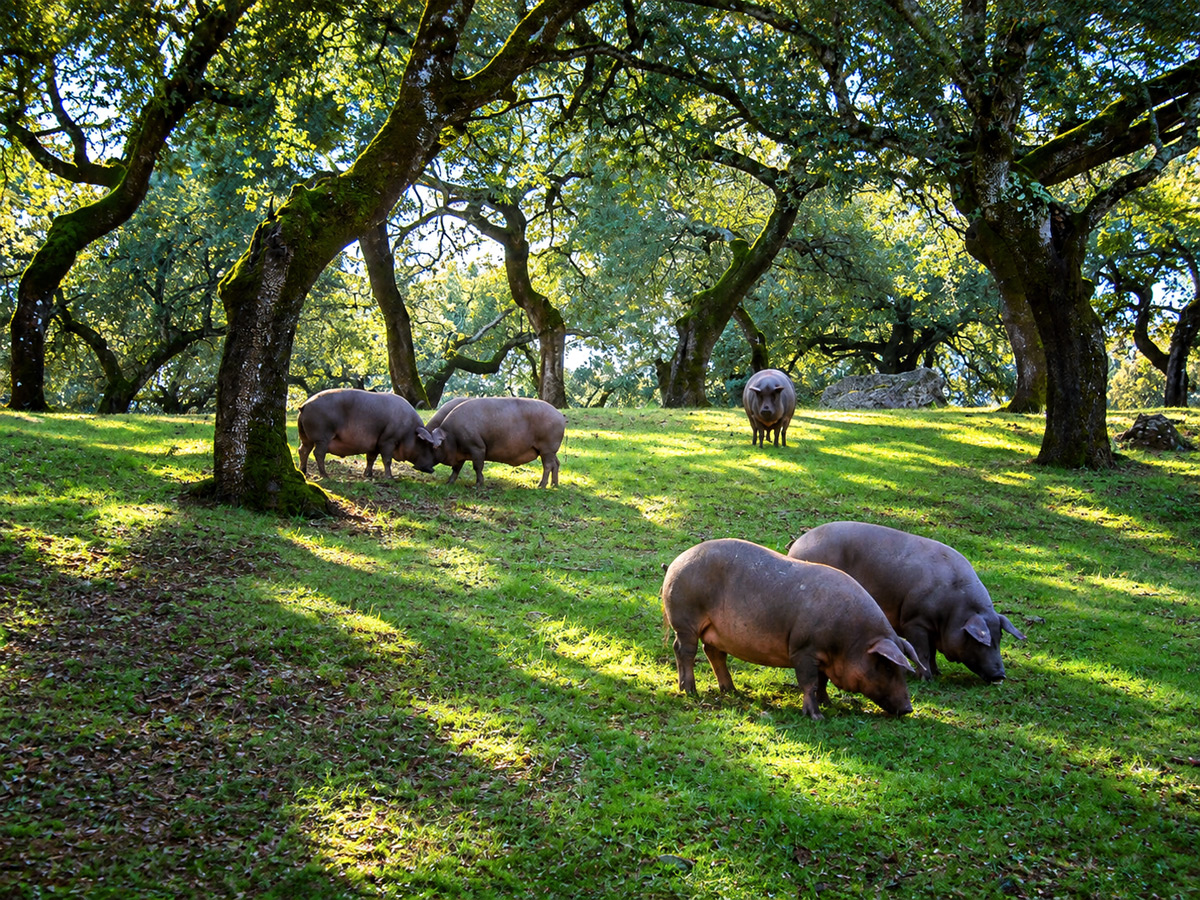
Iberian pigs in the montanera in the dehesa
2.4. Cebo de campo, raised outdoors
The designation's second category is cebo de campo (free-range). The pigs are raised outdoors, either extensively, with 15 pigs per hectare at most on at least one continuous hectare, or in outdoor pens, with 100 m² per animal over 110 kg.
They spend at least 60 days there before slaughter and are fed mainly on cereals and pulses, in addition to what they find on the land. They are slaughtered at 12 months at least. The designation has no "cebo" category, which under the Spanish standard is reserved for pigs reared indoors.
2.5. Slaughtered and identified in the area
Slaughterhouses must be located in the 78 municipalities of the area. Each carcass is weighed on tamper-proof scales: 108 kg at least for a 100% Iberian pig, 115 kg for the others. Carcasses that are too light are rejected.
Each ham and each shoulder then receives a numbered tag (precinto), linked to the pig's rearing batch. This is the start of the traceability that will follow the piece all the way to your table.
3. From drying room to cellar: a thousand days of patience
3.1. Five stages
- Salting: the salt penetrates the meat, for a time that depends on the weight of the piece;
- Washing in lukewarm water, then shaping the ham;
- Resting (post-salado): the salt slowly spreads inwards;
- Drying in a natural drying room, for at least six months;
- Ageing in the cellar, at stable temperature and humidity.
3.2. Climate as an ingredient
The Guijuelo area lies at the heart of the "Dehesa Fría Castellana", the cold dehesa of Castile, at an altitude of around 1,000 metres. Winters last nearly six months and favour slow, natural drying.
Drying takes place in drying rooms with windows open to the outside, opened or closed depending on the weather. When the mild summers arrive, the fat slowly melts and seeps into the muscle: this is the "sudado", the "sweating" of the ham, which gives it its marbling. Humidity and the natural flora also play their part in the curing, overseen by the master ham maker.
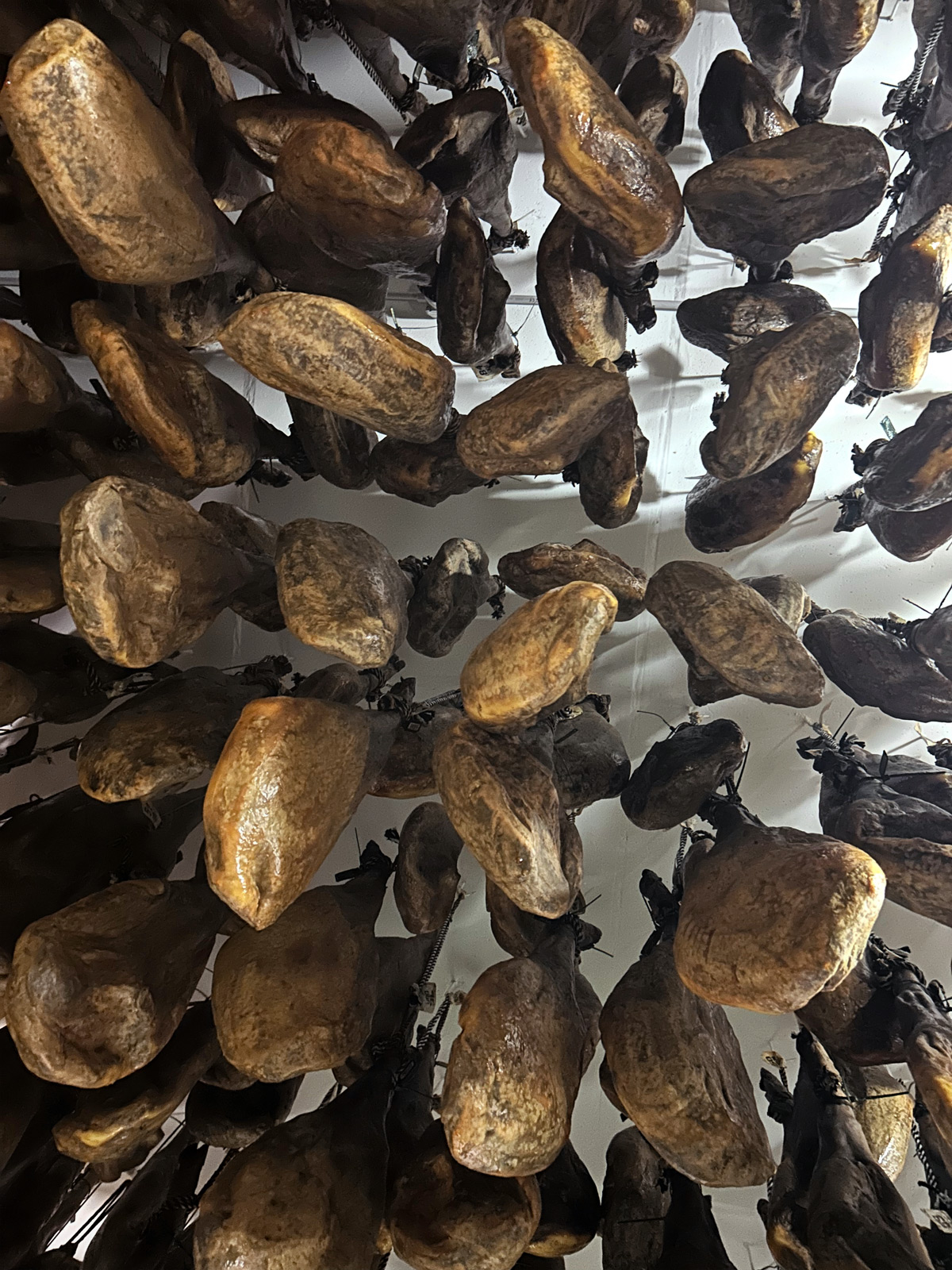
Hams in a natural drying room in Guijuelo
3.3. Some of the longest curing times
The specifications set minimum production times, from salting to leaving the cellar. They go beyond the minimum set by the Spanish Iberian quality standard, which is 600 or 730 days for an acorn-fed ham depending on its weight.
| Piece | Acorn-fed (bellota) | Free-range (cebo de campo) |
|---|---|---|
| Ham | 1,000 days | 800 days |
| Shoulder (paleta) | 600 days | 425 days |
The longest-cured pieces may carry a special mention on their label:
- "Selección": ham cured for 1,250 to 1,500 days, shoulder for 780 to 960 days;
- "Gran Selección": ham cured for more than 1,500 days, shoulder for more than 960 days.
3.4. A portrait of Guijuelo ham
The specifications describe the designation's ham precisely:
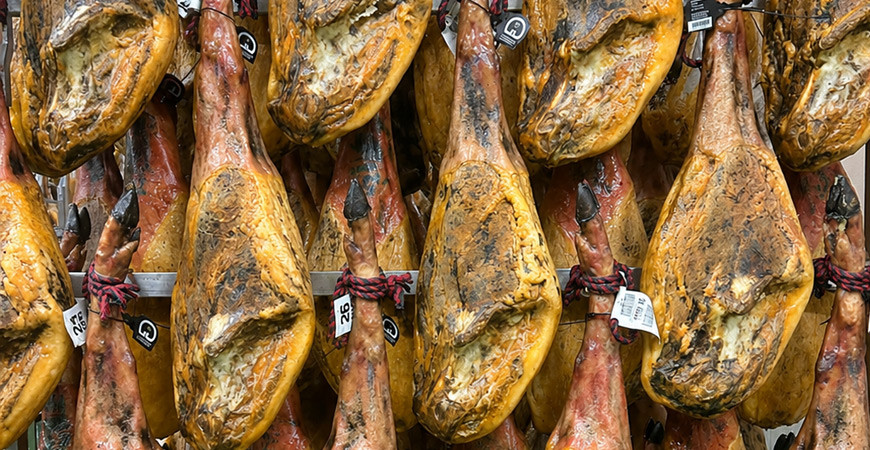
- shape: long and slender, with the hoof kept on;
- rind covered with a white, blue-grey, dark or violet bloom;
- meat pink to purplish red, glossy, streaked with fat;
- flavour delicate, sweet or lightly salted, with a melting, barely fibrous texture;
- fat creamy, glossy yellowish white, aromatic.
In the laboratory, the fat must contain at least 54% monounsaturated fatty acids, including oleic acid, the same as in olive oil. Finished pieces weigh more than 6.5 kg for a 100% Iberian ham and more than 7 kg for the others.
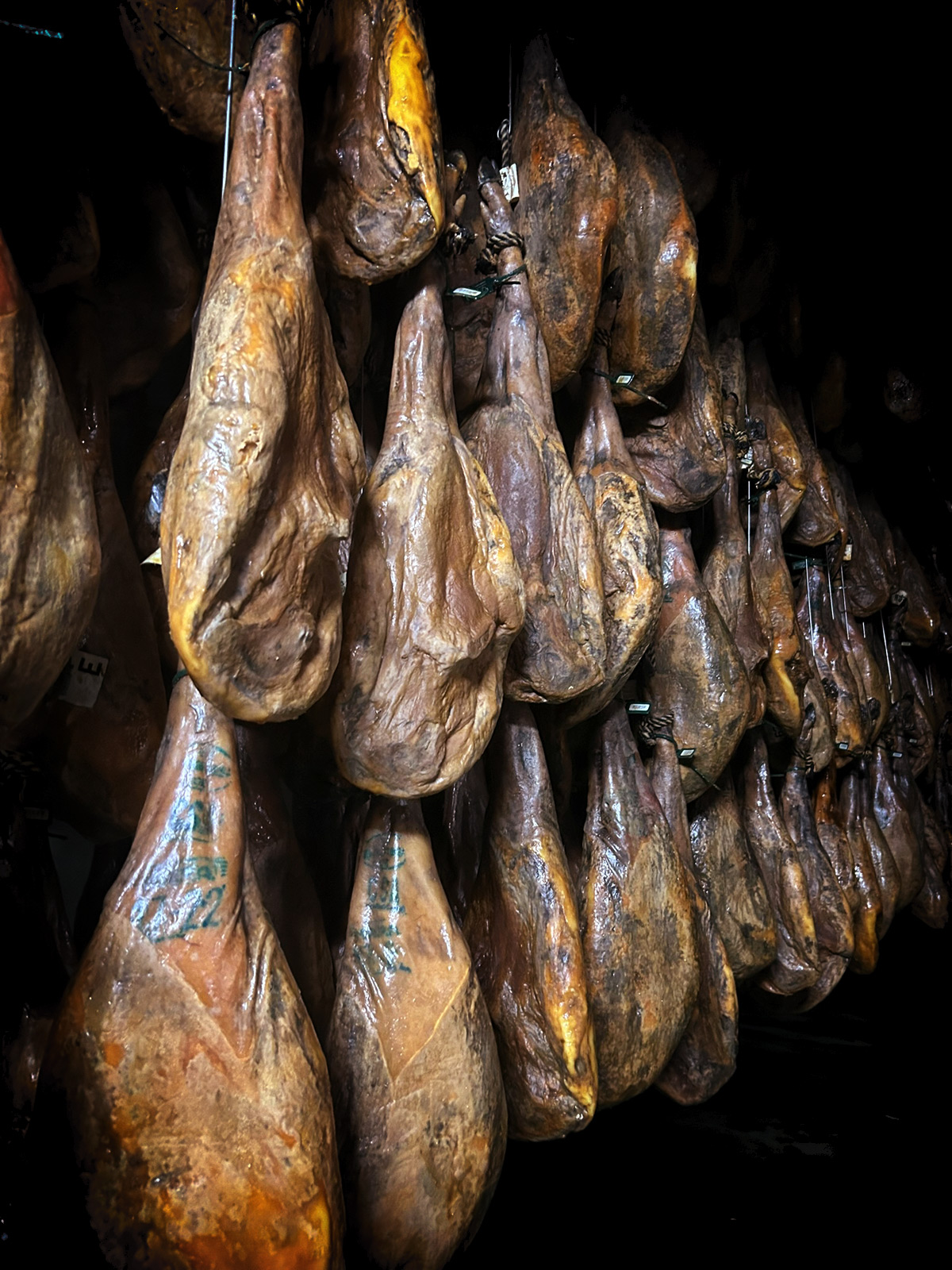
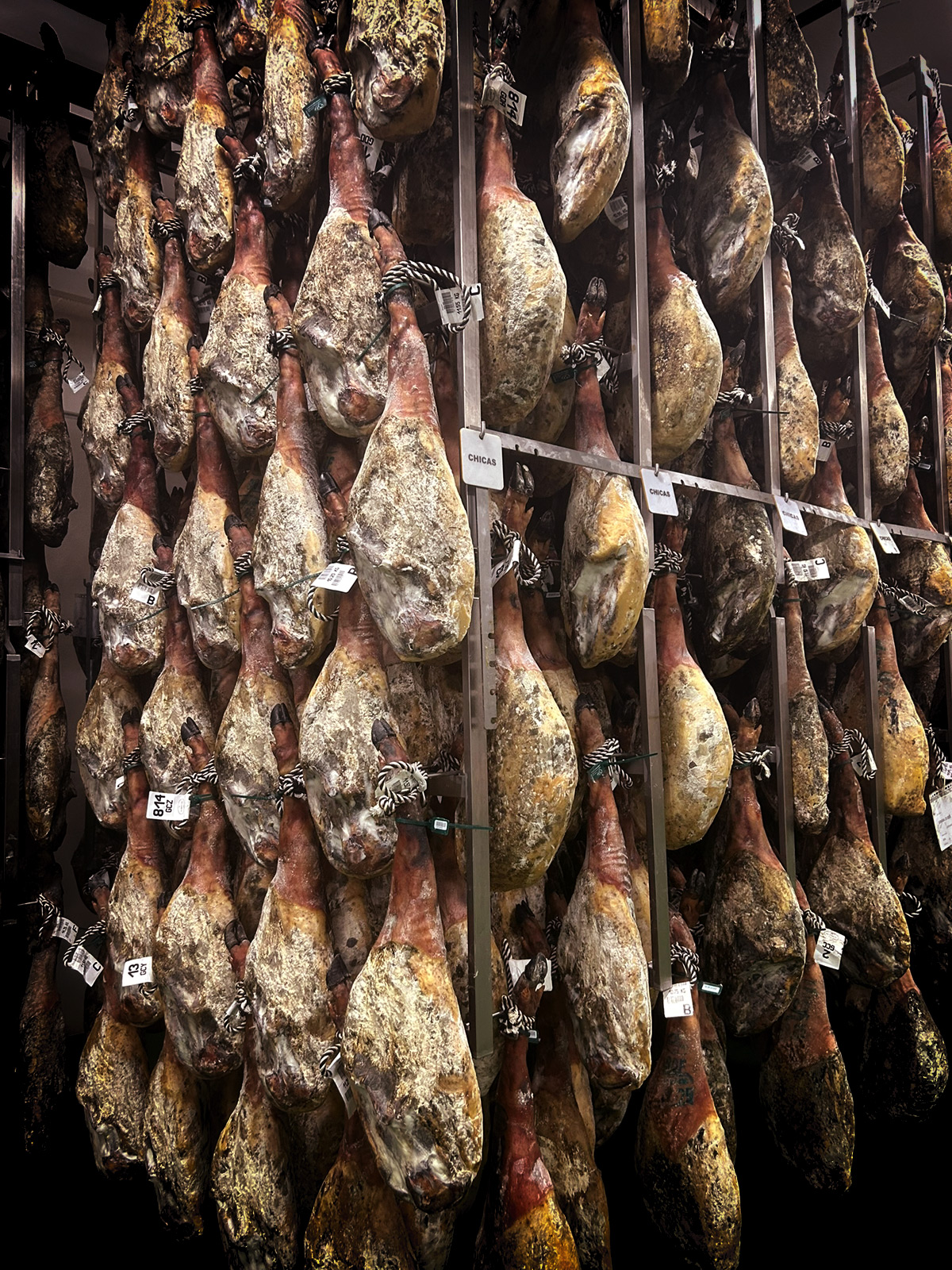
Hams in the cellar, after more than two years of curing
3.5. The journey of an acorn-fed ham
| Stage | When | What the designation requires |
|---|---|---|
| Birth | Two litters a year | Each piglet identified before weaning |
| Entering the montanera | 1 October – 15 December | Average weight of 92 to 115 kg |
| Montanera | More than 60 days | Acorns and grass only, at least 46 kg gained, at least three inspections |
| Slaughter | 15 December – 31 March | In the area, at 14 months at least, carcass of 108 kg or more, numbered tag |
| Salting, washing, resting | Winter | Duration depends on the weight of the piece |
| Drying | At least 6 months | Natural drying room with windows, sudado |
| Cellar | Until at least 1,000 days | Numbered label and brand mark before sale |

4. How to recognise a Guijuelo PDO ham
To find out more about official quality marks, see our page on quality labels.
4.1. Four guarantees
- the numbered tag, fitted at the slaughterhouse and impossible to reuse;
- the numbered label (vitola), fitted in the cellar once the minimum curing time is reached: it states the category and bears the designation's logo and the European PDO symbol;
- the "Guijuelo" logo branded onto the whole piece;
- for boneless, portioned and sliced ham, a numbered back label issued by the Regulatory Council, placed next to the main label.
Tag, label and back label are linked to one another: each piece can be traced back to its rearing batch. Authenticity can also be checked with the "Origen Guijuelo" app.
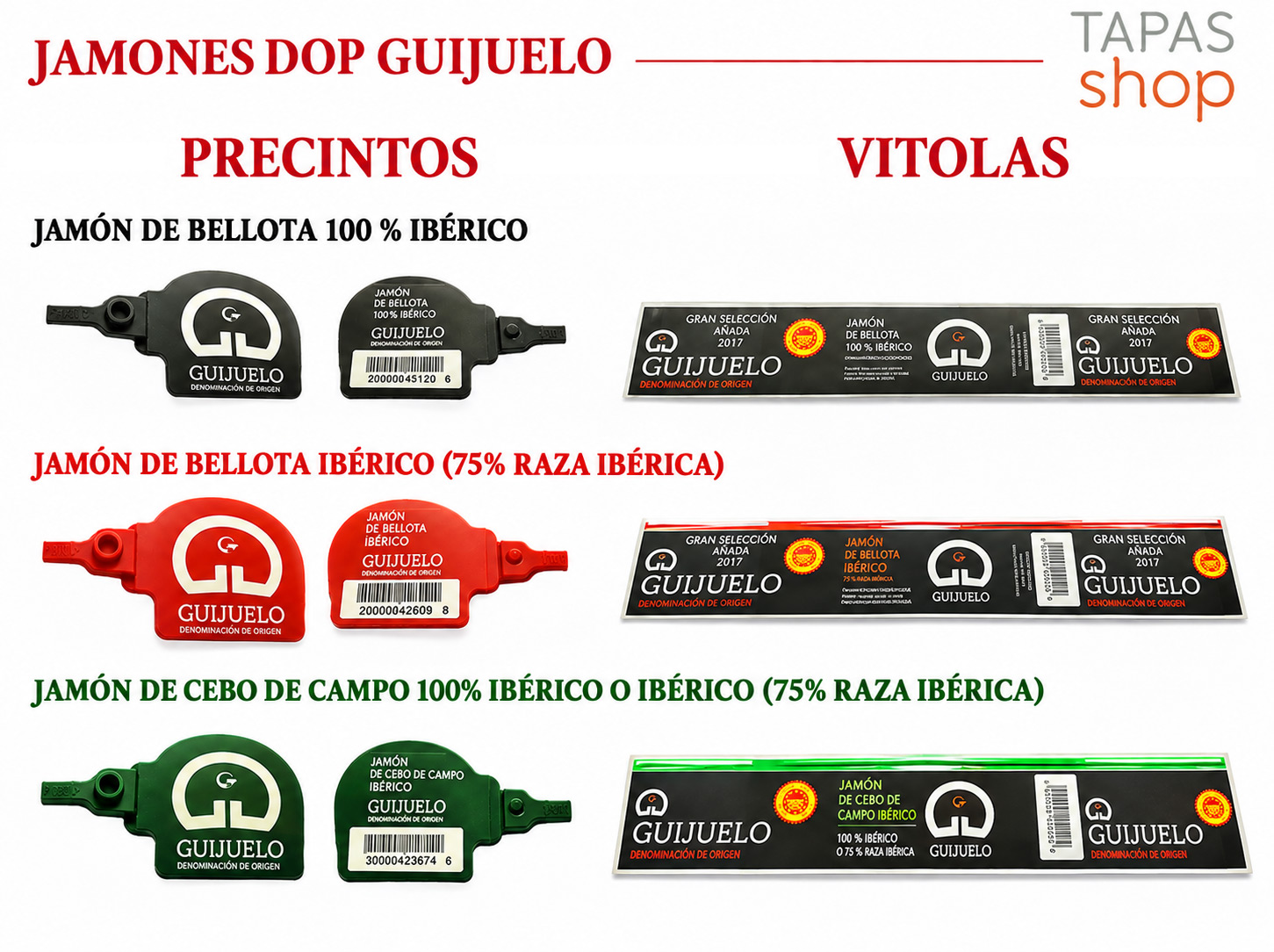
Tag, label and brand mark: the designation's guarantees
4.2. The colours of the tag
| Colour | Guijuelo PDO category | Minimum ham curing time |
|---|---|---|
| Black | Class I: 100% Iberian, acorn-fed | 1,000 days |
| Red | Class II: Iberian, acorn-fed (75% or 50%) | 1,000 days |
| Green | Class III: Iberian, free-range cebo de campo (at least 50%) | 800 days |
The breed percentage always appears on the label. The white tag, used under the Spanish standard for indoor-reared "cebo" pigs, does not exist in the designation.
4.3. Only ham and shoulder are PDO
The designation covers only hams and shoulders. Lomo, chorizo, salchichón or longaniza made in Guijuelo are not part of it: a company selling both must clearly tell them apart. In January 2026, the Regulatory Council applied for a Protected Geographical Indication, "Embutidos de Guijuelo", for these cured meats; the application is under review.
5. Guijuelo and the other Iberian ham designations
Spain has four designations for Iberian ham. Each has its own terroir and rules:
| Guijuelo | Jabugo | Dehesa de Extremadura | Los Pedroches | |
|---|---|---|---|---|
| Production area | 78 municipalities in south-east Salamanca | 31 municipalities in the Sierra de Huelva | Extremadura | North of the province of Córdoba |
| Breeds | 100%, 75% and 50% Iberian | 100% Iberian | 100% Iberian | 100% Iberian |
| Categories | Acorn-fed, free-range | Acorn-fed | Acorn-fed, free-range | Acorn-fed, free-range |
| Minimum curing, acorn-fed ham | 1,000 days | 600 to 730 days depending on weight | Depending on weight | 2 years |
| Acorn-fed pigs, 2025-2026 montanera | around 45,000 | 23,896 | 16,500 | n/a |
| Pieces certified in 2025 | n/a | 132,994 | n/a | 69,577 |
Jabugo
In the Sierra de Aracena, in Andalusia, the Jabugo designation certifies only 100% Iberian acorn-fed ham. Discover our 100% Iberian acorn-fed Jabugo PDO ham from Jamones Eíriz and our article on the Sierra de Aracena.
Dehesa de Extremadura
The designation covers the dehesas of Cáceres and Badajoz, and has certified only 100% Iberian pigs since 2024.
Los Pedroches
North of Córdoba, the Los Pedroches valley produces 100% Iberian hams, both acorn-fed and free-range. Discover our 100% Iberian acorn-fed Los Pedroches PDO ham from La Finojosa.
6. The ham houses of Guijuelo
The designation brings together 40 member companies, based in Guijuelo and the surrounding villages: Ledrada, La Alberca, Campillo de Salvatierra, Sotoserrano… Among them are names such as Aljomar, Julián Becerro, Revisan, César Nieto, Patabrava, Julián del Águila, Monteparra, Blázquez, Lisardo Castro, Pedro Nieto, Maera, El Coto Ramos and the Chacinera Albercana cooperative.
Guijuelo is also home to world-famous houses such as Joselito and Beher, which sell their hams under their own brand.
6.1. Marcial Castro
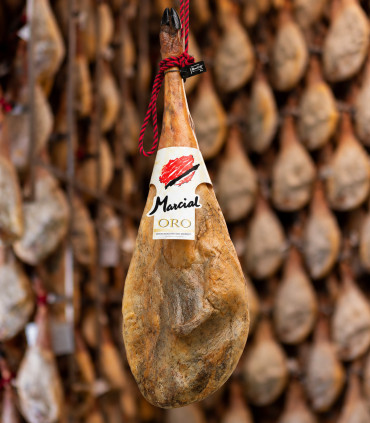
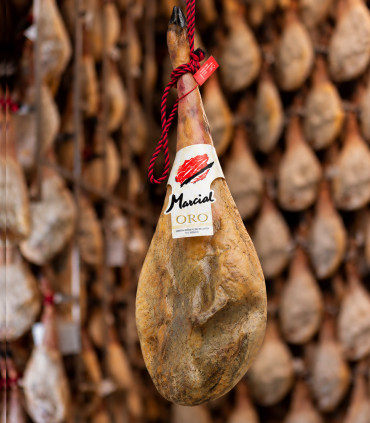
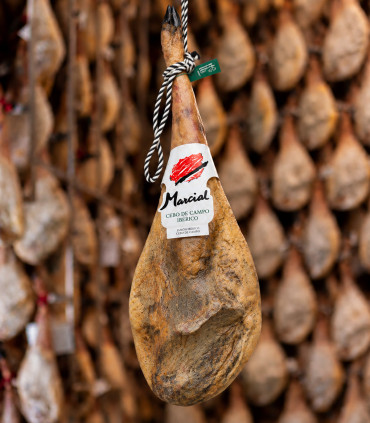
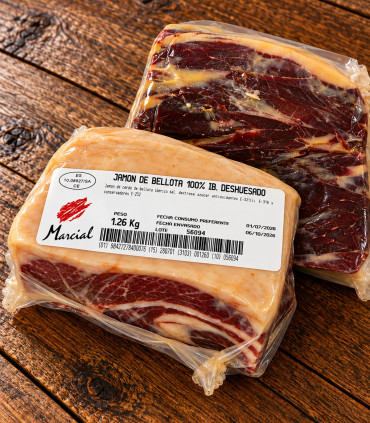
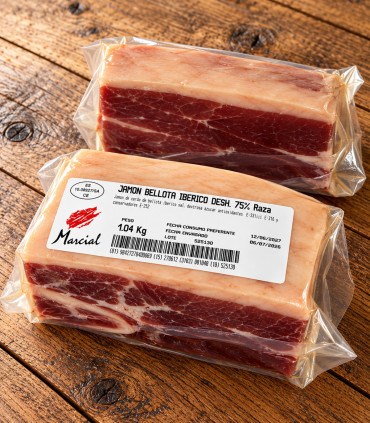
It is in Guijuelo that we chose our producer, Marcial Castro, a family business and member of the designation. Its pigs grow up in the dehesa of Extremadura, then its hams are cured in its natural drying rooms in Guijuelo, exactly as the designation intends.
6.1.1. Guijuelo PDO hams and shoulders to discover
- 100% Iberian acorn-fed ham, Guijuelo PDO (black tag)
- 75% Iberian acorn-fed ham, Guijuelo PDO (red tag)
- 50% Iberian cebo de campo ham, Guijuelo PDO (green tag)
- 100% Iberian acorn-fed shoulder, Guijuelo PDO
- Boneless 100% Iberian acorn-fed ham block
- 100% Iberian acorn-fed ham, hand-sliced
7. How to enjoy Guijuelo ham
Guijuelo ham is best enjoyed at room temperature, between 22 and 24 °C. Take it out at least an hour beforehand: the fat turns glossy and releases its aromas.
- cut thin slices 4 to 5 cm long, with a little fat;
- serve them on a warm plate;
- taste the first slice on its own, without bread;
- pair it with a fino or a manzanilla, the dry sherries of Andalusia, rather than a red wine.
Never put a whole ham in the fridge. Cover the cut surface with a piece of its own fat, baking paper or a cotton cloth. If a whole piece is too much for you, a boneless block or hand-sliced ham is more practical. For more ideas, see our selection of acorn-fed Iberian charcuterie, our Iberian charcuterie platter and our frequently asked questions.
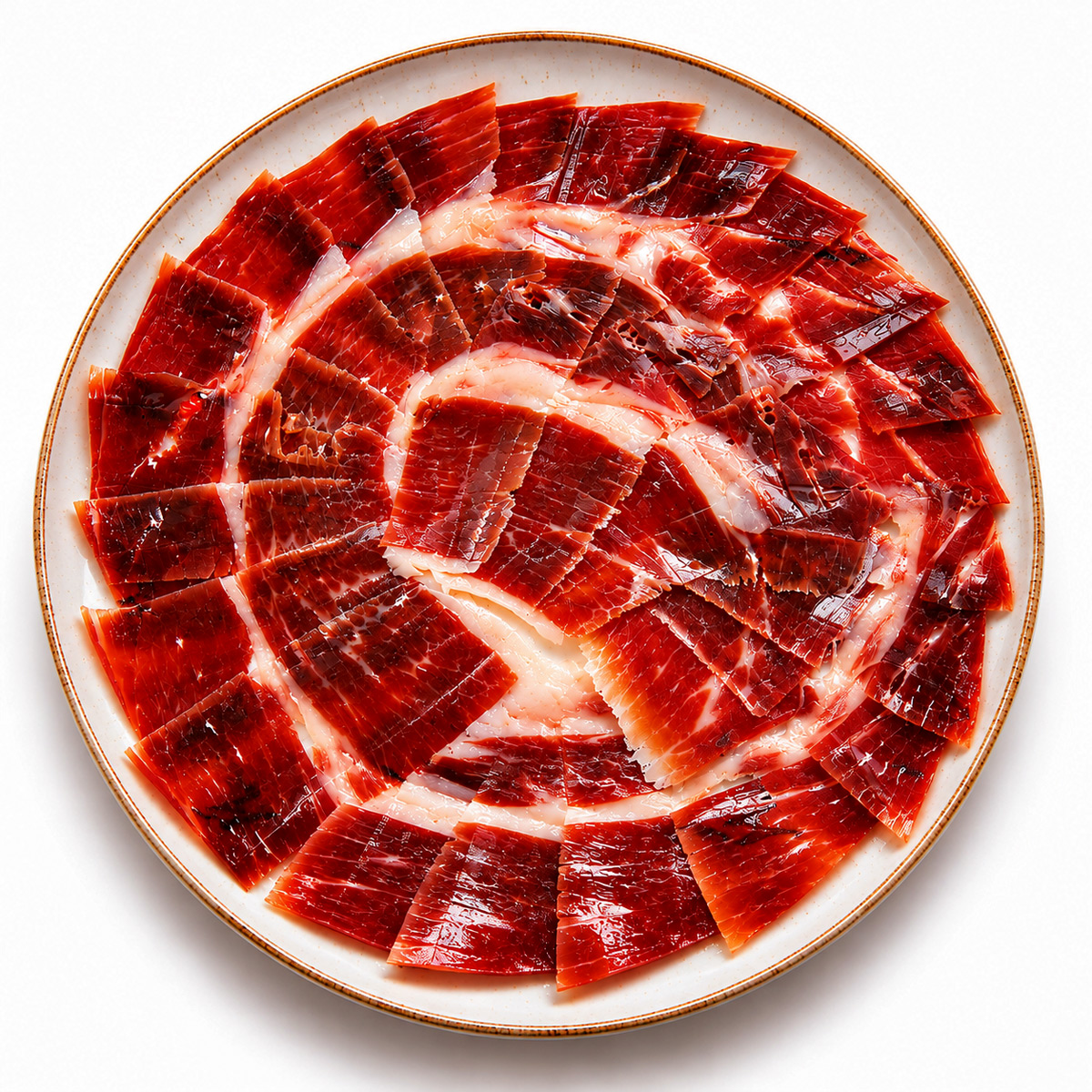
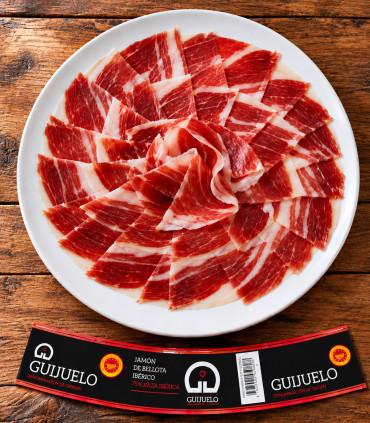
Hand-sliced Guijuelo ham
Conclusion
Since 1986, the Guijuelo designation has protected know-how that dates back to the 16th century in the Sierra de Salamanca. With nearly 45% of PDO-certified acorn-fed pigs in 2025-2026, it remains the largest in Spain.
What makes a Guijuelo ham is, first of all, a controlled dehesa, with at most 1.25 pigs per hectare during the montanera. Then comes a mountain climate: long, dry winters and drying rooms open to the sierra. Finally, there are at least a thousand days of patience for an acorn-fed ham, and traceability that follows each piece from the farm to your table.
With Marcial Castro, TAPAS Shop invites you to discover these acorn-fed and free-range hams, and to recognise their black, red and green tags at a glance.
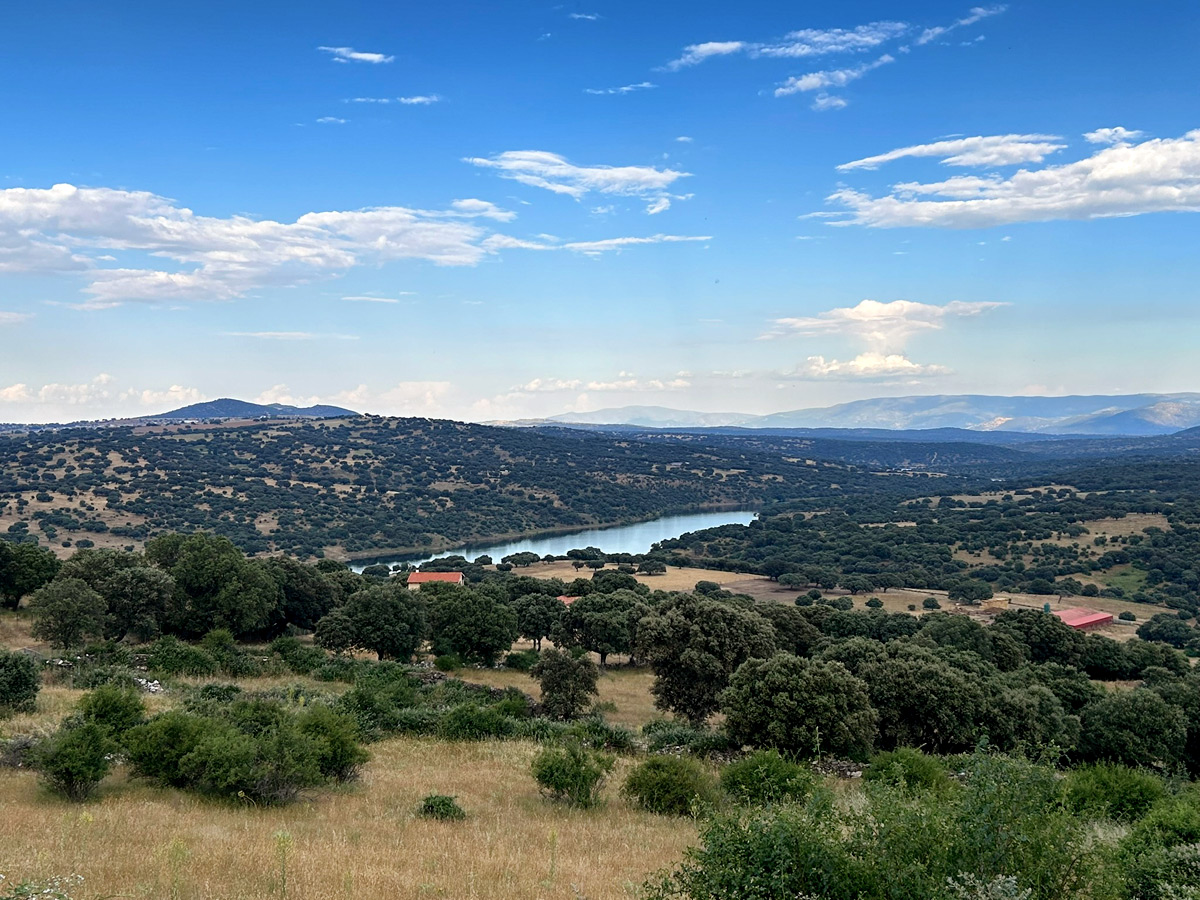
The Salamanca dehesa, on Guijuelo's doorstep
Frequently asked questions about Guijuelo ham
What is the difference between Guijuelo ham and Jabugo ham?
Both are Iberian hams with a designation of origin, but they come from different places: Guijuelo is made in the Sierra de Salamanca, in Castile, at around 1,000 metres; Jabugo in the Sierra de Huelva, in Andalusia. Guijuelo certifies 100%, 75% and 50% Iberian pigs, both acorn-fed and free-range; Jabugo only 100% Iberian acorn-fed.
What does the black, red or green tag on an Iberian ham mean?
The colour shows the category. Black: 100% Iberian, acorn-fed. Red: Iberian crossed with Duroc, acorn-fed. Green: free-range cebo de campo. Under the Guijuelo designation, the tag also bears the designation's name or logo.
Is Guijuelo ham always 100% Iberian?
No. The designation accepts 100%, 75% and 50% Iberian pigs. The percentage is always shown on the label, and only the black tag guarantees a 100% Iberian acorn-fed ham.
How long is a Guijuelo PDO ham cured?
At least 1,000 days for an acorn-fed ham, nearly three years, and 800 days for a free-range ham. Beyond 1,250 days, the ham may carry the "Selección" mention, and beyond 1,500 days "Gran Selección".
Is Guijuelo chorizo PDO?
No. The designation covers only hams and shoulders. A PGI "Embutidos de Guijuelo", for lomo, chorizo and salchichón, was applied for in 2026.
What is cebo de campo ham?
It is ham from an Iberian pig raised outdoors and fed mainly on cereals and pulses, in addition to the natural resources of the land. Under the Guijuelo designation, it carries a green tag and is cured for at least 800 days.
Iberian ham glossary
PDO / DOP
Protected Designation of Origin; in Spanish, Denominación de Origen Protegida. It guarantees a geographical origin, a set of specifications and independent controls.
Bellota
Spanish for acorn. A "bellota" pig has been fattened on acorns during the montanera.
Montanera
The season when pigs fatten freely in the dehesa, from October to March, as the acorns fall from the oaks.
Dehesa
Open woodland of holm oaks and cork oaks, typical of western Spain, where Iberian pigs graze.
Cebo de campo
Iberian pig raised outdoors and fed mainly on cereals and pulses. Green tag.
Cebo
Iberian pig reared indoors and fed on cereals. White tag. This category does not exist in the Guijuelo designation.
Duroc
A pig breed of American origin, crossed with the Iberian pig for its early maturity and yield.
Precinto
The numbered tag fitted on the leg at the slaughterhouse. Its colour shows the ham's category.
Vitola
The numbered label fitted in the cellar at the end of curing. It bears the category, the designation's logo and the European symbol.
Paleta
The shoulder, the pig's front leg. Smaller than the ham, it needs less curing time.
Sudado
The "sweating" of the ham: in spring and summer, the fat slowly melts and seeps into the meat, creating the marbling.
Secadero and bodega
The drying room, with windows open to the outside, and the cellar, where the ham finishes ageing.
Selección and Gran Selección
Guijuelo designation mentions for the longest-cured pieces: over 1,250 days and over 1,500 days for a ham.
Pata negra
"Black leg": the popular name for Iberian ham, after the colour of the hoof. To find out more, see our page on pata negra and designations.
Sources:
- Guijuelo PDO Regulatory Council and specifications, version 8-2025
- BOE (Spanish Official Gazette), amendment to the specifications, 1 September 2025
- BOE, statutes of the Regulatory Council
- Spanish Ministry of Agriculture, Fisheries and Food (MAPA)
- ASICI, Iberian Pig Interprofessional Association (ITACA system)
- Forbes España, 2025-2026 montanera
- Ferias, Mercados y Mataderos, review of the 2025-2026 montanera
- Interempresas, DOP Guijuelo
- Jabugo PDO Regulatory Council
- Dehesa de Extremadura PDO specifications
- COPE Pozoblanco, Los Pedroches PDO 2025 review
- BOE, PGI application "Embutidos de Guijuelo"